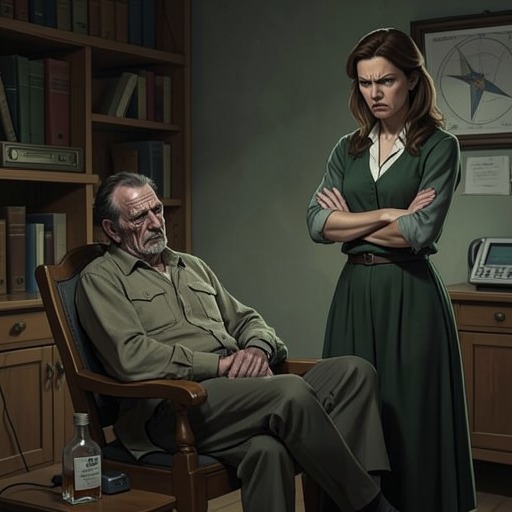
Cholly's parental abandonment
The Bluest EyeCholly's parental abandonment is the formative condition of his childhood: his mother leaves him on a railroad junk heap when he is four days old, and his father later rejects him when he comes looking for him. The novel makes these two acts of abandonment a key to Cholly’s isolation, but not an absolution for the harm he causes. His history illuminates how a life can be shaped by violence and deprivation without making its later violence inevitable or harmless.
Identity and Background
Cholly is abandoned first by his mother, who wraps her four-day-old baby in two blankets and a newspaper and places him on a junk heap beside the railroad. His Great Aunt Jimmy finds him and takes him in. The discarded materials and exposed location mark the beginning of a life in which care arrives only after a parent has already left him to chance.
The account adds a possible explanation for his mother’s disappearance: Cholly’s family believed she was not right in the head. But the explanation cannot be confirmed through her own account. She runs away shortly after an incident involving a razor strap, and no one hears from her again. Cholly grows up grateful that Aunt Jimmy saved him, though the narrative qualifies that gratitude: at times, watching her eat collard greens with her fingers and suck her gold teeth, he is reminded of what he has lost and cannot settle into uncomplicated thankfulness.
Searching for His Father
As an adult, Cholly seeks out Samson Fuller, his father, and approaches him cautiously, asking whether he is the man he has come to find. Fuller responds not with recognition or welcome but with suspicion, asking who sent Cholly and whether he is Melba’s boy. The questions place Cholly outside the relationship before he has managed to establish who he is.
Fuller eventually throws money on the ground for Cholly to pick up. He tells him to give a message to the woman who sent him and orders him out of his face. The money is not an offer of kinship: it is a dismissal, coupled with an assumption that Cholly has been sent to collect it. Cholly takes a long time to lift his foot from the ground and struggles to back away. The physical delay conveys the force of the rejection without turning the encounter into reconciliation.
Isolation and Its Limits
The narration describes Cholly as free after being abandoned by his mother and rejected for a crap game by his father: he has nothing more to lose and is alone with his own perceptions. That freedom is starkly double-edged. It is a release from the authority of a family that has not sustained him, but it is also freedom without a secure bond or protective home. The two parental failures leave him with no dependable relationship to return to.
This account matters because the novel places Cholly’s later conduct beside, rather than outside, his beginnings. As an adult, he sexually assaults his daughter, Pecola. His abandonment helps explain the emotional and social desolation from which he acts; it does not transform his assault into an unavoidable consequence or reduce its injury to her. The distinction keeps the reader from confusing understanding a history with excusing what that history does not justify.
Retrospective Structure and Significance
The novel reveals Cholly’s infancy and search for his father within a wider account of violence against children and the ways adults fail to protect them. In another childhood scene, Frieda tells Claudia that a man touched her, and the sisters try to understand the violation in the limited terms available to them. Elsewhere, a woman describes being told that Black women deliver babies without difficulty or pain, as if they were horses. These different episodes do not make Cholly’s abandonment and the girls’ sexual vulnerability identical; together, they show a world in which children’s bodies and needs are often treated as available to adults rather than entitled to care.
The adult narrator’s stated interest in telling a story of female violation from the perspective of girls themselves frames the novel’s attention to who gets heard and who is left unprotected. Cholly’s remembered abandonment adds a different, male childhood wound to that inquiry, but it does not displace the girls’ experience. The paired parental rejections help explain the isolation that shapes his life, while the narrative’s separation of explanation from excuse preserves the moral weight of his actions.